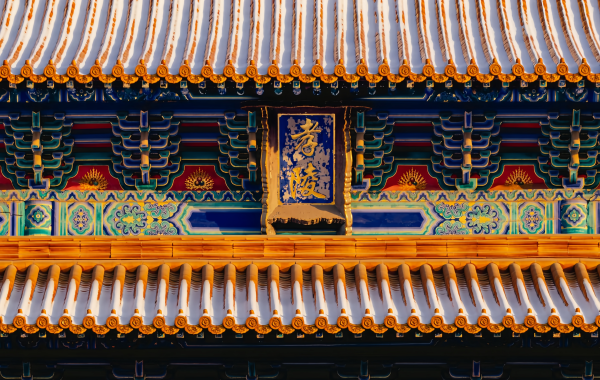
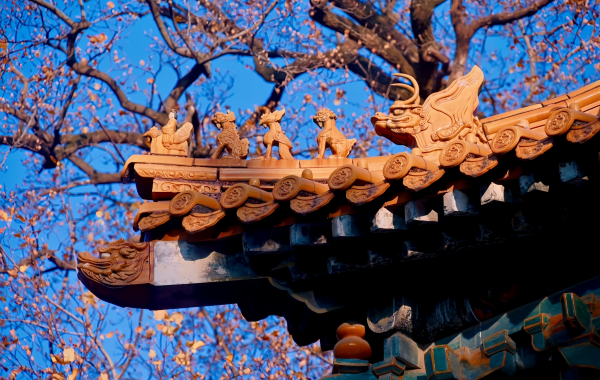
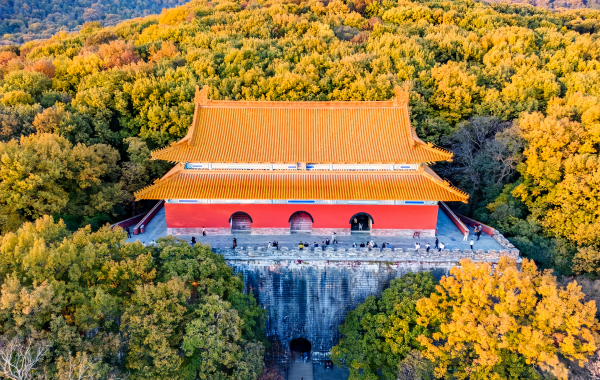
Humanistic Ingenuity—An Exemplary Imperial Mausoleum Setting the Standard for Five Centuries
The architecture of the Ming Xiaoling Mausoleum constitutes a grand narrative woven from themes of power,ritual protocol,and artistic expression.
1.The Dismounting Archway and Guidance Zone:Imperial Majesty
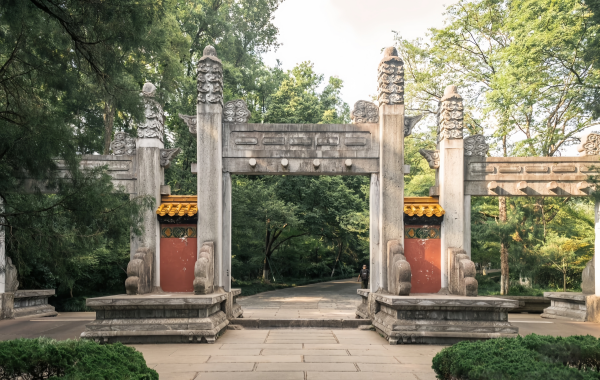
The official starting point of the Ming Xiaoling Mausoleum is the Dismounting Archway(Xiamafang),situated on the eastern slope of Weigang.This structure is a stone paifang(ceremonial archway)featuring two pillars that soar skyward;inscribed upon its horizontal lintel are six large characters in standard script(kaishu):"All Officials Must Dismount."Upon reaching this point,civil and military officials visiting the mausoleum were required to dismount and proceed on foot to demonstrate their reverence for the founding emperor.The processional way—stretching over 700 meters from the Dismounting Archway to the Great Golden Gate—sets a solemn stage for this imperial mausoleum.
2.The Pavilion of the Stele of Divine Merit and Sacred Virtue(The Square City):A Father-Son Bond
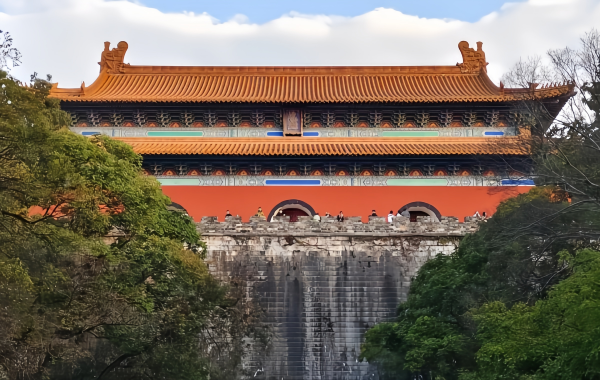
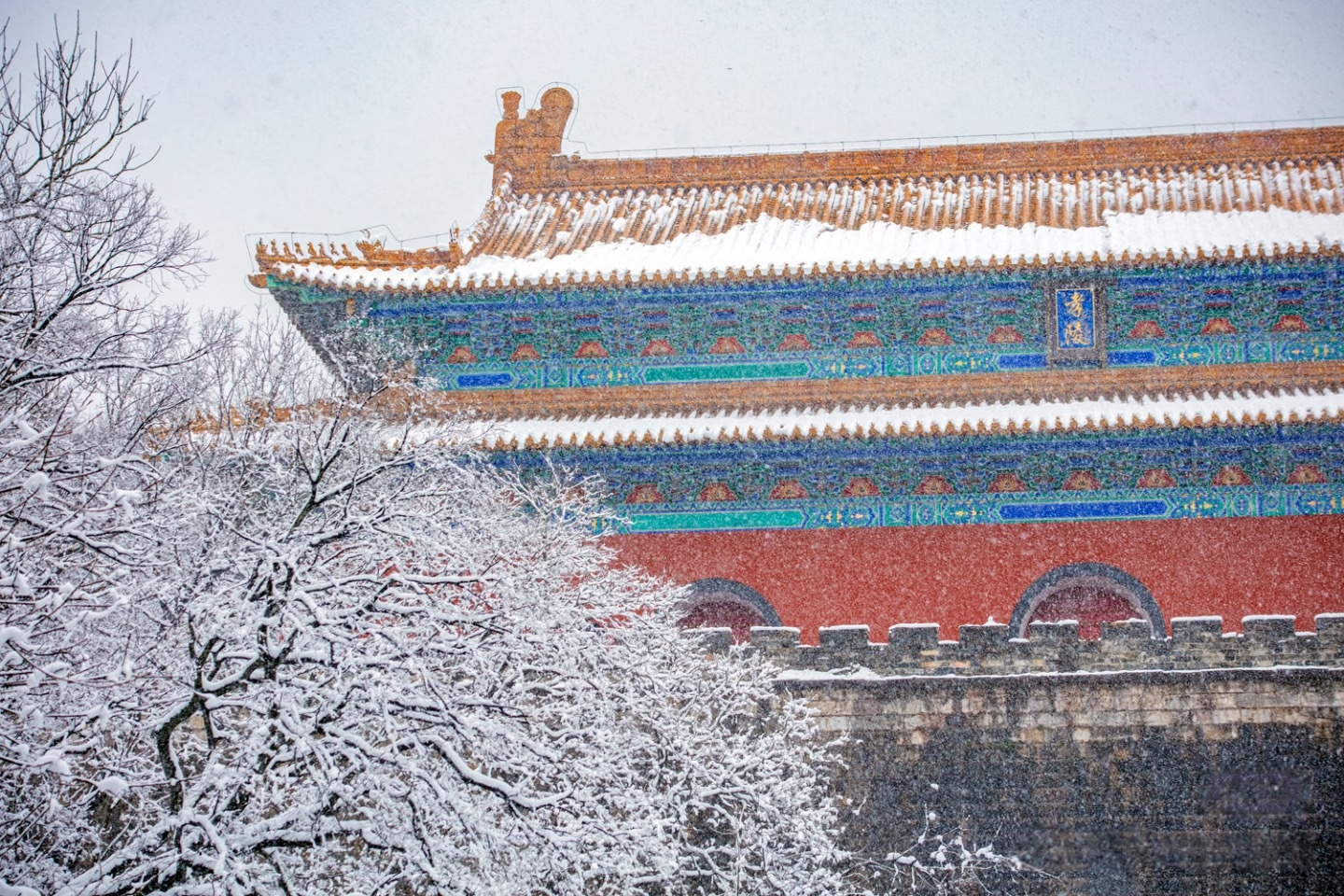
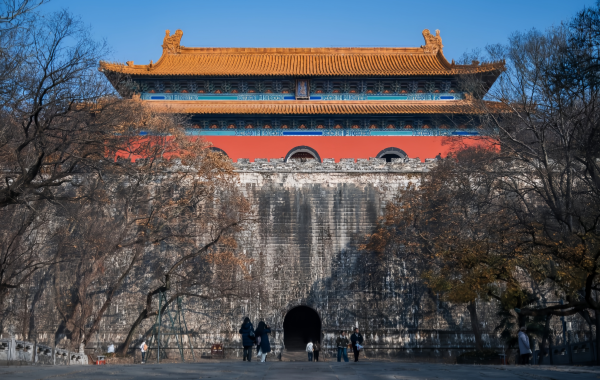
Inside the Great Golden Gate stands a square pavilion structure,popularly known as the"Square City."Although the pavilion's roof was destroyed long ago,its four walls still stand tall and imposing.Housed within is the"Stele of Divine Merit and Sacred Virtue of the Ming Xiaoling Mausoleum,"standing 8.78 meters high.It was erected by the Yongle Emperor(Zhu Di)to extol the virtues and achievements of his father,Zhu Yuanzhang.The inscription—penned personally by Zhu Di—recounts the lifetime accomplishments of Zhu Yuanzhang and serves as a vital primary source for the study of early Ming Dynasty history.
3.The Stone Elephant Road and the Wengzhong Road:An Open-Air Gallery of Stone Sculpture
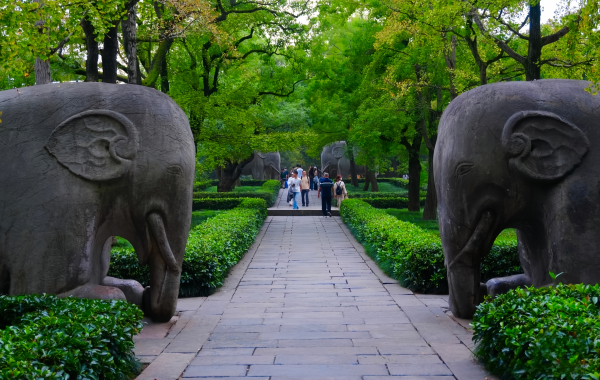
Crossing the Imperial River Bridge,one enters the most quintessential section of the Xiaoling Mausoleum:the Sacred Way.This processional route,spanning approximately 800 meters,consists of two segments—the Stone Elephant Road and the Wengzhong Road.Winding and curving along the contours of Plum Blossom Mountain,the path traces the distinctive pattern of the Big Dipper constellation.
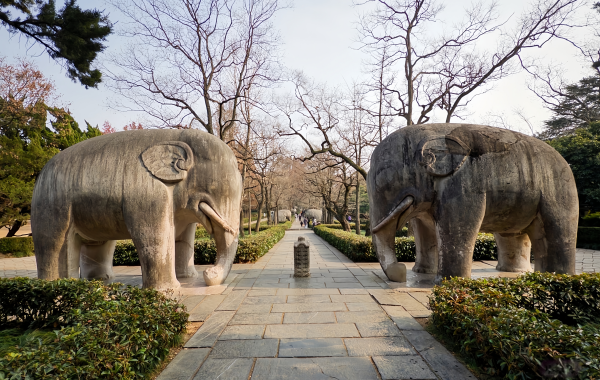
Lining the Stone Elephant Road are stone sculptures of six different animals:lions,Xiezhi(mythical justice beasts),camels,elephants,Qilin(mythical benevolent beasts),and horses.Arranged in pairs—two kneeling and two standing—there are two pairs of each animal type,totaling 24 sculptures across 12 pairs,standing guard on either side of the path.Each stone beast carries its own symbolic significance:the lion,as the king of beasts,signifies imperial majesty;the Xiezhi,known for its upright nature,represents the ability to discern right from wrong;the camel symbolizes the vast expanse of the Great Ming Empire's territory;the elephant,with its sturdy legs,signifies the stability of the realm;the Qilin,a benevolent creature,symbolizes a"benevolent and righteous ruler";and the horse represents the steed upon which the emperor rode to unify the empire.Among these sculptures,the stone elephants are the heaviest,weighing in at a staggering 80 tons each.During their original transportation,a remarkable feat of engineering was employed:the ground was watered in winter to create a frozen,icy surface,and the massive stones were rolled into place using bamboo and wooden rollers,powered entirely by human effort.
At the end of the Stone Elephant Road stands a pair of white stone ornamental pillars(Huabiao),towering 6.25 meters high;it is at this point that the Sacred Way turns northward.Upon entering the Wengzhong Road,one encounters eight stone statues standing opposite one another—four representing military generals and four representing civil officials.The generals are clad in armor and hold golden shields,while the officials wear court crowns and carry ceremonial tablets.The term"Wengzhong"originally referred to Ruan Wengzhong,a legendary strongman during the reign of Qin Shi Huang;it later evolved into a generic term for the stone figures guarding imperial tombs.A humorous anecdote from the Qing Dynasty recounts the story of a Hanlin scholar who mistakenly wrote"Wengzhong"as"Zhongweng."Emperor Qianlong playfully penned a satirical imperial rescript in response:"How can'Wengzhong'be inverted to'Zhongweng'?Ten years of arduous study,yet your scholarship remains deficient.You are no longer fit to serve in the Hanlin Academy;as punishment,you shall be demoted and dispatched to Jiangnan to serve as a lowly magistrate."
4.The Square City,the Ming Tower,and the Treasure Mound:A Revolutionary Transformation in Tomb Architecture
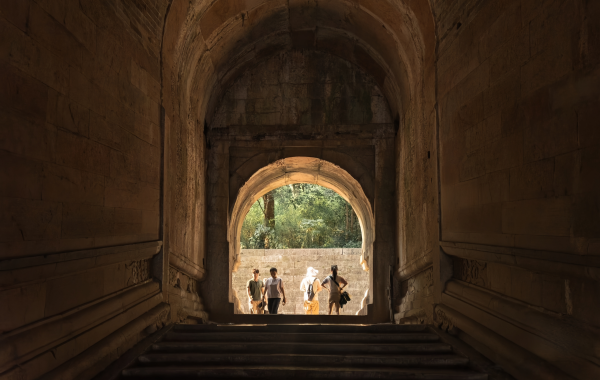
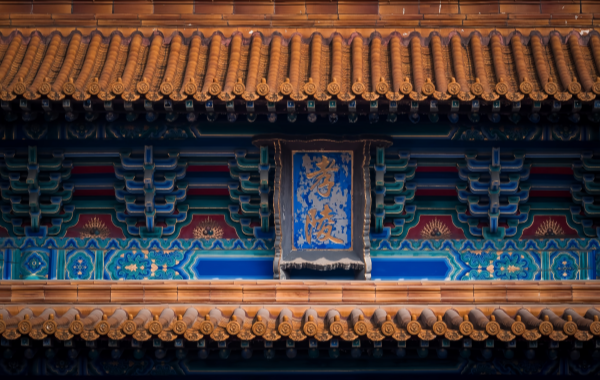
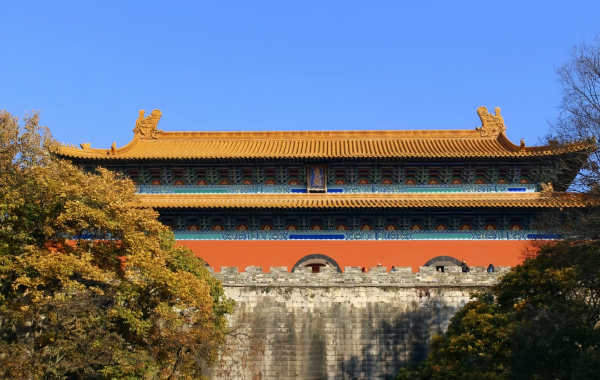
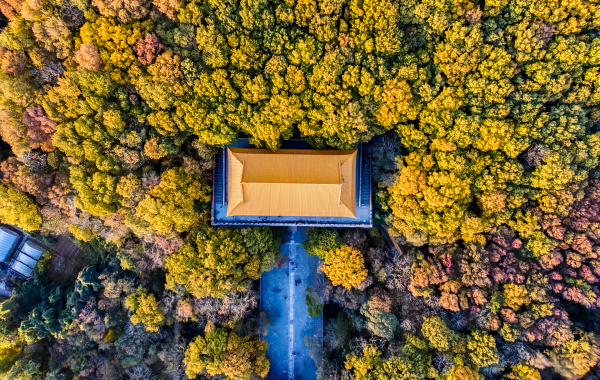
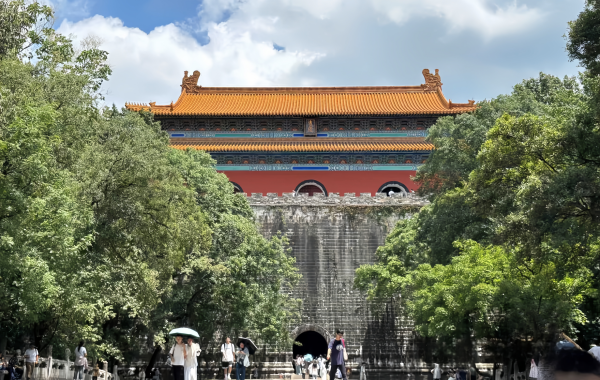
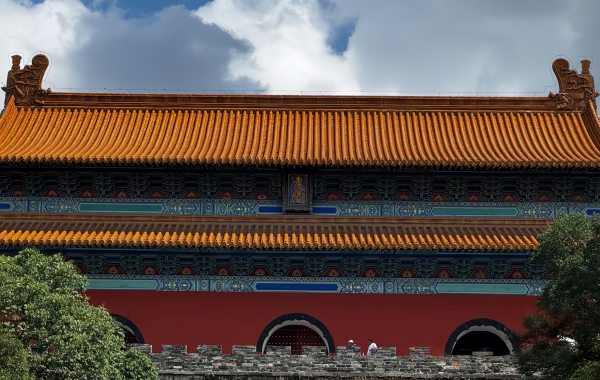
After passing through the Lingxing Gate and the Golden Water Bridge,one enters the main architectural complex of the mausoleum palace.The wooden structures—such as the Gates of Civil and Military Officials and the Sacrificial Hall—were largely destroyed during the Taiping Rebellion;the structures standing today are reconstructions dating from the late Qing Dynasty.However,the structures located at the rear—the Square City,the Ming Tower,and the Treasure Mound—remain the original constructions from the Ming Dynasty.The Square City(Fangcheng)is the largest structure within the Xiaoling Mausoleum,measuring 75 meters in length(east-to-west),31 meters in width(north-to-south),and standing over 16 meters tall.Running through the center of the Square City is a vaulted tunnel;after ascending 54 steps and emerging from the tunnel,one sees the seven characters"This Mountain is the Tomb of the Ming Founder"(Ci Shan Ming Tai Zu Zhi Mu)carved into the southern wall of the Treasure Mound.The Treasure Mound(Baoding)is circular in shape;situated directly beneath it lies the underground palace housing the remains of Zhu Yuanzhang and Empress Ma.Modern magnetic surveying techniques have confirmed that the underground palace remains perfectly preserved and has never been looted;it lies buried dozens of meters beneath the Wanzhu Peak of Dulongfu Hill.
In terms of imperial tomb systems,the Ming Xiaoling Mausoleum introduced three major innovations:transforming the traditional square burial mound into a circular one;establishing a mausoleum layout characterized by a square front section and a circular rear section;and abolishing the"Lower Palace"(Xiagong)structures typical of Tang and Song Dynasty imperial tombs while simultaneously expanding the"Upper Palace"(Shanggong)complex.These systemic innovations were fully adopted and perpetuated by the Thirteen Tombs of the Ming Dynasty in Beijing,as well as by the various imperial tombs of the Qing Dynasty,thereby influencing the architectural design of Chinese imperial mausoleums for over five hundred years.
Photography Tips:
The Stone Elephant Road:In the early morning or late evening,when the sunlight strikes at an oblique angle,the shadows cast by the stone beasts become elongated,creating images with dramatic visual tension.Autumn—when the ginkgo trees turn a brilliant golden hue—is the absolute best season for photography here.
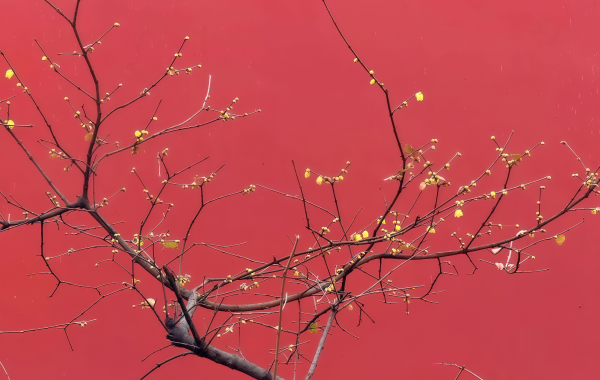
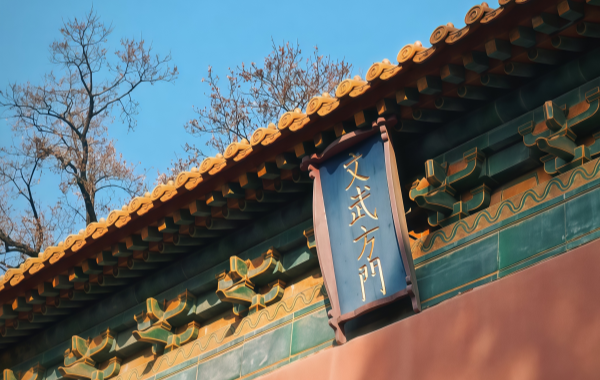
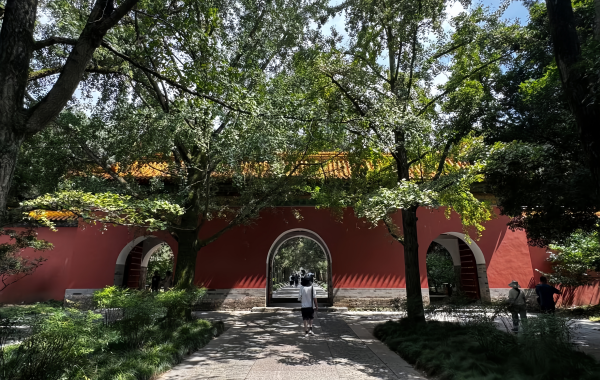
The Square City:Try shooting upward from inside the structure to capture the Shen Gong Sheng De Stele(Stele of Divine Merit and Sacred Virtue);this angle creates a powerful sense of depth and verticality within the frame.Red Walls:The red walls near the Wenwu Square Gate serve as an excellent backdrop for portrait photography.
Drones:Drone flight is prohibited in most areas of the Zhongshan Scenic Area;please strictly adhere to the park's regulations.
Nature's Masterpiece—A Four-Season Tapestry at the Foot of Purple Mountain
The allure of the Ming Xiaoling Mausoleum lies not only in its architectural and cultural heritage but,more importantly,in its seamless integration with the natural environment of Zhongshan Mountain.
1.Plum Blossom Hill(Sun Quan's Tomb):The Foremost Plum Blossom Sanctuary Under Heaven
Plum Blossom Hill was originally the burial site of Sun Quan,the Great Emperor of Eastern Wu.It earned its name—and its current reputation as the"Foremost Plum Blossom Sanctuary Under Heaven"—due to the extensive planting of plum trees throughout the area.From late February to mid-March each year,the hillsides burst into bloom with plum blossoms,transforming the site into a veritable"World of Plum Blossoms."The area is home to numerous rare varieties;if you are lucky,you may even catch a glimpse of the rare Lü'e(Green-Calyx)plum blossoms.Situated atop the hill is the"Memorial Hall of Sun Quan,Great Emperor of Eastern Wu,"where visitors can learn about the life of Sun Quan and his connection to the city of Nanjing.
2.The Four Seasons of the Stone Elephant Road:A Single Path Through Spring,Summer,Autumn,and Winter
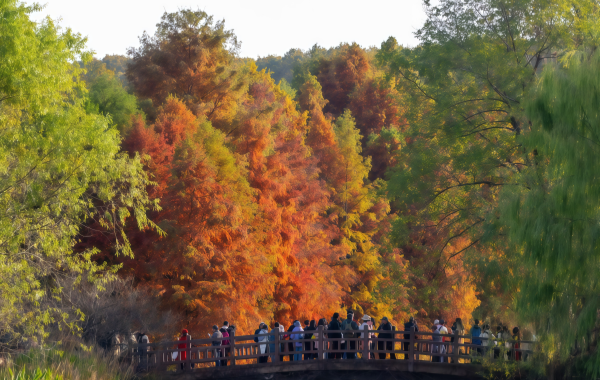
The Stone Elephant Road is hailed as Nanjing's"most beautiful 600 meters."In spring,the path is flanked by vibrant greenery;in summer,a dense canopy of leaves provides deep,cooling shade;in autumn,it transforms into a"Golden Tunnel,"where the golden hues of ginkgo trees intermingle with the crimson foliage of maple trees;and in winter,draped in a mantle of snow,the road takes on a unique and enchanting charm.
3.The Purple Mountain Forest Sea:A Natural Oxygen Bar Within the City
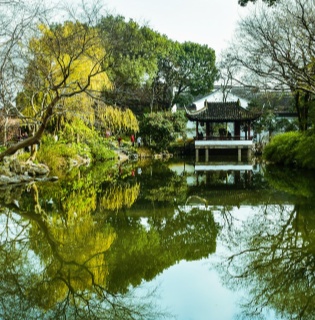
The Zhongshan Scenic Area,home to the Xiaoling Mausoleum,boasts an exceptionally high forest coverage rate.As you stroll through the grounds,you are surrounded by towering ancient trees and breathe in crisp,fresh air.Within the mausoleum complex,visitors can admire ancient and renowned trees such as the Southern Yew and the Camphor tree.Arriving early in the morning—when the forest mist weaves together with the interplay of light and shadow—offers the perfect opportunity to engage in a"forest bath,"a truly rejuvenating experience for both body and soul.